Background
Visionary designer Young Huh has built her career on a conviction that the best interiors hold opposing ideas in tension. Her work combines vivid color and tasteful restraint, respect for tradition, and an embrace of what feels fresh and new. Seemingly incongruous textures and patterns find a way to belong together. Above all, she designs for emotion. "The first thing I look for is the mood I want to feel," she says. "That's where the design story starts."
When Huh and her husband discovered a property in the Hudson Valley dating to 1820, she saw something beyond its neglected state. The landscape was extraordinary: a private lake, old growth trees, geese tracing patterns overhead. The house itself was a patchwork—a Federal-era center hall flanked by wings added in the 1980s, each speaking a different architectural language. But for a designer who thrives on the interplay of diverse elements, this wasn't a problem. It was an invitation.

I think it's important to respect the history of a space but also bring it into the modern age. There has to be a balance of revering things that were here, but also being absolutely free to layer on your own personality.
This would be Huh's family home and her laboratory. A place to tell her own story, experiment with ideas she might bring to clients, and enjoy the full privileges of a designer who finally gets to be her own client.
Objective
Huh began with a question she asks at the start of every project: How do I want to feel in each room? In the kitchen, she wanted brightness and conviviality. In the bedrooms, refuge and calm. In the sunroom, connection to the natural world beyond the glass. Underlying the renovation was an awareness of the role light would play in distilling these distinct feelings. "Lighting is so important to how we experience mood," Huh notes.
This project—Huh's most personal yet—would require light to serve a range of purposes. It would need to keep her family connected to the extraordinary, ever-shifting landscape around them. It would need to evoke the feelings they wanted to experience at different moments. Finally, the light would need to serve Huh's intricately crafted interiors, vividly rendering the materials and textures that imbue each space with character.
Accomplishing this would mean treating natural and electric light as part of a continuous, dynamic medium to be sculpted and shaped throughout the day. Controlling the experience would need to feel natural and uncomplicated. Huh was happy to use the best technology available—but that technology couldn't interfere with her aesthetics.
Challenges
The home's layered history presented obstacles at every turn. Construction phases separated by more than a century meant inconsistent ceiling heights, mismatched window proportions, and uneven rooflines. The kitchen was the most challenging space. Forty feet long but with low ceilings, it was dark, cavernous, and starved for natural light, yet intended to be the heart of daily life. And while the 1820s living room had the generous, consistent daylight its original builders intended, nothing tied the home's varied spaces into a unified experience of light.
Huh's design ambitions raised the stakes further. She was committed to a richly detailed, densely layered interior—painterly Korean wallpaper in the entry hall, deep greens enveloping the primary bedroom, lacquered Italian cabinetry in the kitchen alongside country furnishings. Such a bold palette demands light that renders color faithfully. Static LEDs would feel flat, unable to adapt to the changing light outside or conjure different ambiences.
Huh needed light that could follow her materials and moods through every register, from the bright energy of a working morning to the candlelit intimacy of an evening gathering. And she needed that light to come from everywhere—harnessing sunlight at the window and coordinating it with full-spectrum tunable electric light deep into the space. "The biggest misunderstanding about light is people don't understand that it needs to be layered," Huh says. "You can't just have recessed lights and expect to have beautiful lighting."
The Solution
Lutron provided a way to bring Huh's vision to life—an integrated system of intelligent fixtures, motorized window treatments, and intuitive controls that work together, transforming light into a dynamic element of interior design.
Waking Up with Nature
Huh's day begins with a simple gesture. From her bed, the press of a Palladiom keypad lifts her Roman shades to reveal morning light filtering through the trees and reflecting off the lake.
My first experience of the day is to push the shade button and the shades lift up and I see the lake and the grounds. I wake up looking at nature. It's a magical experience.
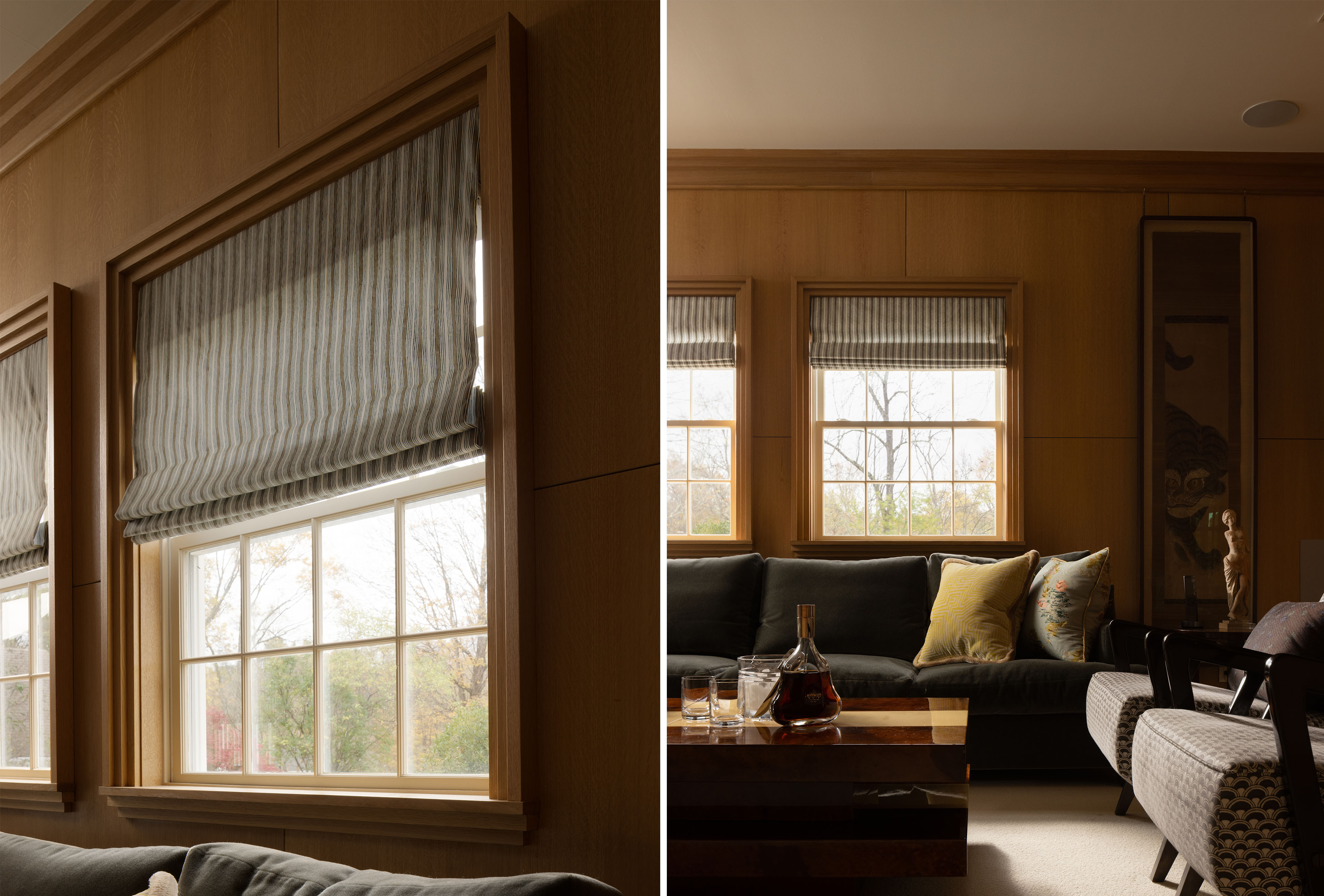
The Romans, automated with Lutron's Triathlon system, are fitted in a fabric printed with leaves that swirl into tendrils and arabesques by the French designer Madeleine Castaing. "The surprise is that they're also motorized," Huh says. "So it's an example where technology and handmade craft come together for a really beautiful product."
In the library, shades reduce UV exposure to help preserve the important artworks that line the walls. They also modulate the intensity of direct sun so that the experience of being immersed in natural light remains comfortable. Throughout the house, automated shading serves as the first layer of light control, curating sunlight so the transition from outdoors to in feels seamless and intentional.


Interior Light That Follows the Sun
Where the shades sculpt daylight, Ketra fixtures bring dynamic, natural-feeling light into the interior. Controlled by a location-aware, intelligent system, Huh's Ketra downlights and linears can match the precise color temperature of the light outside or shift instantly to create the right feeling for the moment at hand.
In the kitchen, this effect is most dramatic. Once a dark, low-slung room, a new atrium skylight floods the space with natural light. Ketra downlights work in concert: on bright mornings, they match the sky's crisp hue for cooking and focused work; on overcast days, they compensate with warm, natural-feeling illumination; and as evening falls, they shift to a candlelit glow that makes the large room feel intimate. "On dark days, you want to have this feeling of being flooded with really beautiful light," Huh says.
We can really change the mood and atmosphere of a room. I don't think there's any other lighting in the world that is tunable like the Ketra lights.


Controls That Disappear
For Huh, modern convenience and historic character don't conflict—they elegantly coexist. Throughout the home, Palladiom and seeTouch keypads are finished to cooridinate with the room's materials: in some spaces they echo surrounding decorative accents, in others they are wallpapered over entirely, vanishing into the pattern. The effect is deliberate and tactile—part of the room's design rather than a distraction from it.
"I don't think that having modern keypads is somehow not in keeping with a historic house," Huh says. "I love being able to enter a room and touch a button, and the lights are set to a certain mood. I love seeing modern touches integrated with historic elements."
Preset scenes calibrated to the family's rhythms—morning energy, afternoon ease, evening warmth—allow the entire home to shift with a single touch, while remaining flexible enough for the spontaneous adjustments that life demands.
Results
The home that emerges is one that responds—flexibly and intuitively—to the life that happens inside it. Every transition is fluid; every room tuned to its purpose. And the technology that makes it possible is woven into the wallpaper, hidden behind handmade textiles.
Huh honored her property's long history while making choices no previous owner could have imagined—a Korean mural in a 19th century entryway, Italian cabinets in a country kitchen, a spectacle of prints and patterns that few designers could pull off.
I think great technology is kind of hidden, and if you use it well, it's going to enhance the experience. You would never know the amount of technology that goes into the controls and lights in our house.
Today, her Hudson Valley family home also serves Huh's design practice. Having lived with the Lutron system, she brings her firsthand experience to client conversations—demonstrating how Intelligent Lighting and automated window treatments don't compete with handcrafted interiors but enhance them.