

Background
With their previous space occupying lower-level floors and sandwiched between other Manhattan office buildings, a prominent global financial firm knew its new office space had to prioritize abundant natural light above all else. They engaged architect M Moser Associates to apply data-driven rigor to design an office space that maximizes daylight. Ultimately, the team selected 9 upper-level floors in an office building near Hudson Yards with incredible, 360° views of the city.
From the outset, the project was engineered around three core deliverables: thermal comfort, acoustic performance, and access to daylight—with smart, automated lighting and shading playing a central role in all three.
We worked with specialists across the global team to run extensive solar studies across every facade. That daylight modeling directly informed material selections and design strategies for each space, ensuring that our choices were purposeful and effectively supported our goals.


Design Goals
1. Support employee well-being and productivity by maximizing access to natural light.
2. Design the lighting so that all spaces, especially interior offices, would achieve a minimum of 100 lux for at least 50% of the workday.
3. Prioritize indirect, glare-free electric lighting with minimal downlights throughout the floorplates.
4. Design for adaptability to accommodate evolving space configurations and advances in technology.
Challenges
Although the project was focused on bringing in as much natural light as possible, that light also had to be carefully controlled. Automated shades that could be programmed to raise/lower in tandem with the sun’s path would be crucial to protect employees from both the sun itself and the oftentimes unpredictable glare that comes from the many neighboring high-rises. Throughout the space, M Moser and Syska Hennessey, who provided lighting design services, were challenged to use indirect lighting as much as possible to give the space a soft glow, mitigating internal glare that can come from direct lighting sources such as downlights.
The project also required a lighting design that ensured adaptability as the project progressed and lighting requirements were refined. The selected lighting and control system had to be capable of adapting quickly—without rewiring, schedule delays, or budget overruns. Finally, the entire design process was informed by the client’s desire for academic rigor to support each design decision. Modeling, simulations, and on-site verification processes were required to determine the best strategy for harvesting as much daylight as possible, and to confirm performance against established targets. 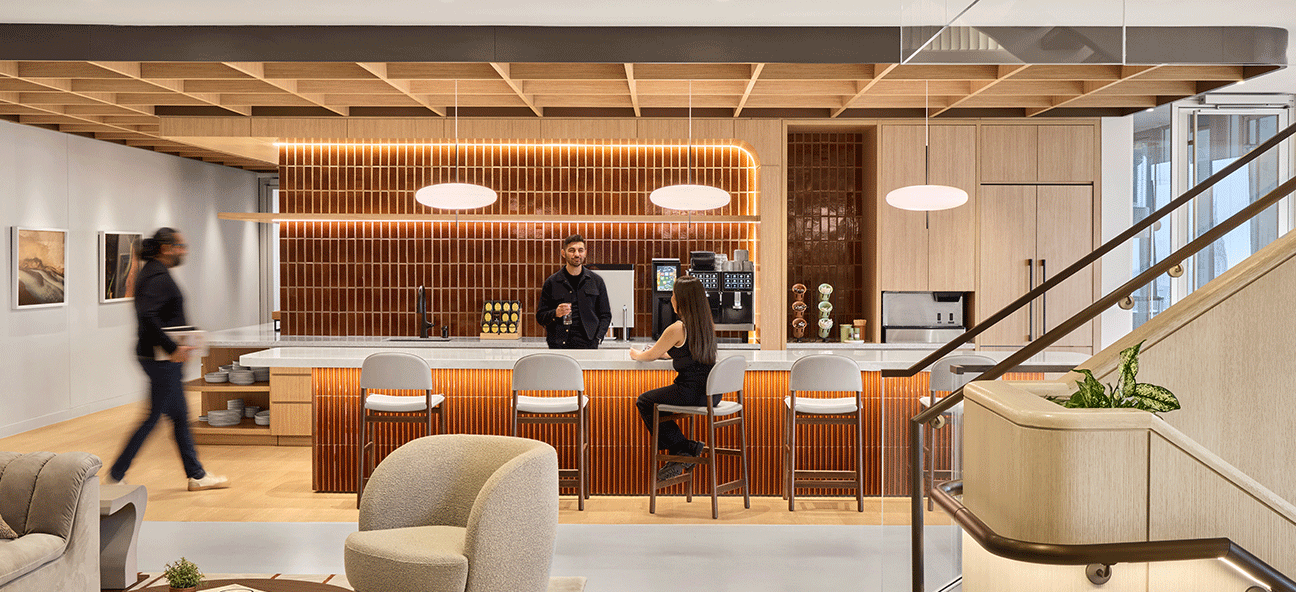
The Solution
Shading for All Seasons
Guided by the extensive daylight modeling and glare studies, the team looked at a wide variety of options, including German parabolic shades, light shelves, and automated shades. M Moser concluded that the best solution was a unique, dual-shading configuration using Lutron’s automated solar shades paired with its Athena lighting control system.
Each window is equipped with two automated roller shades in coordinating fabrics—Basketweave 27 in 1% openness factor and Basketweave 27 in 5% openness factor in Oyster/Charcoal color. Openness Factor (OF) denotes the tightness of the fabric weave and is expressed as the percentage of light that transmits through a solar screen fabric without being redirected or diffused. Thus, a lower OF indicates a tighter weave with less light penetration, while a higher OF means a more open mesh that allows more daylight in.
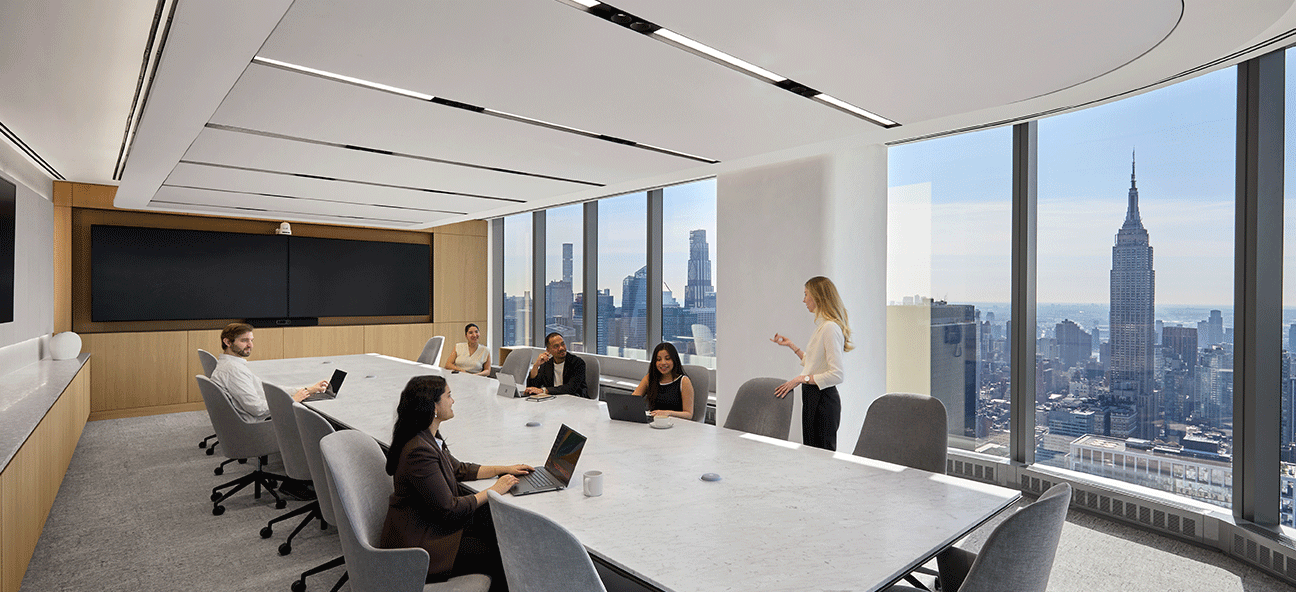
While a single, 5% shade could have been used to meet the target lux levels, modeling showed that sunlight would exceed comfort thresholds at certain times. During periods of intense, direct daylight, the 1% shades are automatically lowered to maintain the required lux while eliminating uncomfortable glare. The 5% shades are deployed during times of more indirect sunlight exposure. To avoid a moiré pattern that could occur as a result of combining different openness factors, the shades are never lowered at the same time.
The shades initially operated on Athena's standard solar automation protocol, but unexpected reflections from an adjacent building prompted further adjustment. M Moser worked closely with Lutron’s service team to program a custom solution that effectively blocked the glare while still maximizing sunlight. The automated, dual-shade approach seamlessly balances view, daylight access, and glare control without requiring any manual intervention, leaving employees free to focus on their tasks.
Designing for the Future
The indirect, tunable white lighting is designed to deliver soft light throughout the space, complementing available daylight rather than competing with it. Lutron’s Athena wireless nodes enable granular control of each lighting fixture, simplifying late-stage design changes and providing long-term flexibility as layouts continue to evolve.
With a client who is so deeply committed to employee well-being and comfort, changes to the lighting system programming are inevitable. Thus far, more than a dozen bulletins and design-change requests have been received, requiring hundreds of individual adjustments. With Athena wireless nodes in each fixture and standard power and technology, changing a room’s function is as simple as moving the furniture and adjusting the light settings – no rewiring required.


By investing in adaptable wireless lighting technology, the client was able to offer employees with private offices a choice of 12 different, standard configurations, allowing them to position desks, digital whiteboards, and seating where they preferred. Private office lighting can be adjusted via local wall controls or an app, while open office areas and shared spaces are controlled via pre-programmed, time-based scenes or by the facilities team on an as-needed basis. Conference rooms also feature default programming with intuitive, in-room controls. The final product is a dynamic lighting and shading solution finely tuned to today’s needs and built to adapt seamlessly over time.
Results
The completed workplace consistently meets performance targets while ensuring employee comfort. Since occupying the space in September 2024, employee feedback has been overwhelmingly positive, particularly when compared to the firm’s previous location. Beyond the office areas, the space offers corners of retreat and restoration—from quiet areas of recluse with expansive views to a state-of-the-art wellness room.
Ultimately, the project demonstrates how data-driven lighting solutions, intelligent shading, and flexible control systems work together to create an environment where people can focus, perform, and thrive—without distraction. The integrated Lutron lighting and shade solution sets the standard for automated control that doesn’t compromise comfort, efficiency, or flexibility.


