

Project Overview
According to the National Institutes of Health (NIH), mosquito-borne disease affects 100s of millions of people and costs an estimated annual global cost of $12 billion USD each year. Since 1946, Clarke has been developing and delivering the most environmentally responsible solutions for managing the public health impacts of disease-carrying and nuisance insects to help make communities around the world safer, more livable, and more comfortable.
To carry out the complex research and testing necessary to combat and control mosquitoes, and to keep pace with growing resistance to existing control methods, Clarke completed a major overhaul of its mosquito insectary in June 2026. A Lutron Athena lighting control system with Athena wireless nodes was key to delivering customizable control in each of 5 research chambers.
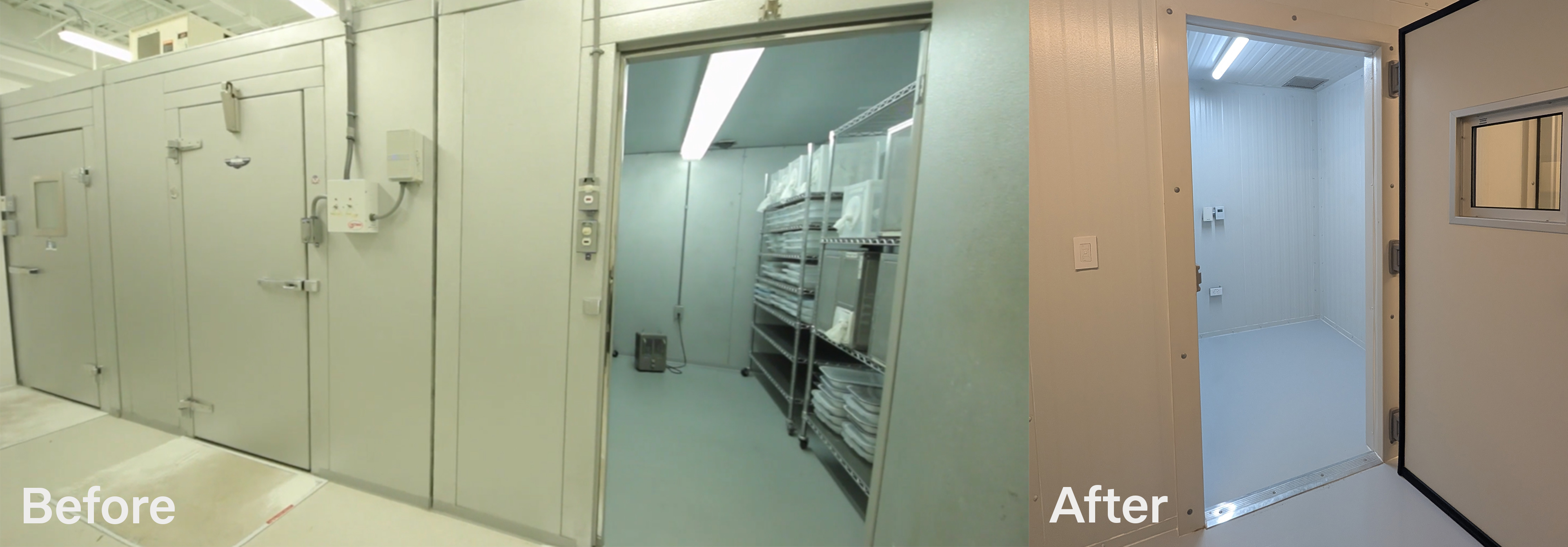
Before the facility upgrades, mosquito colonies were housed in 3 commercial freezers retrofitted with temperature, lighting, and humidity controls. These environmental aspects could be adjusted for the overall system but couldn’t be individualized within each freezer chamber. The new system would need to support granular control, be budget-conscious, and install quickly as mosquitoes had to be re-housed and research halted during construction.
A lighting and control system upgrade with a wireless Lutron Athena system addressed budget, timeline, and functionality at once. The wireless approach reduced installation time and cost and H. E. Williams fixtures fitted with Athena wireless nodes allow each space to be individually programmed to meet the needs of any species. The upgraded insectary features 5 modular chambers, each with the capability to tailor the light, temperature, and humidity level to each species’ unique requirements. This customization is critical to encourage the feeding, breeding, and indoor survival essential for successful research – especially with species like Anopheles mosquitoes, which have a highly complex life cycle and fail easily in improper conditions.
When you’re rearing multiple species or resistance-selected strains simultaneously, shared environmental controls can compromise your data.
The insectary’s intricate programming requirements were handled through the Lutron app – another advantage of the wireless Athena system.
The Clarke team received intensive training on the system, the app, and the programming process to ensure they could quickly adjust the chamber’s settings to match the unique needs of new populations. Clarke team members reported: “It made sense quickly, and adjustments were a lot easier than we thought they would be. The product’s design makes it very intuitive.”
Derek Drews added, “Now we can really mimic a Darwin chamber—[an expensive, pre-fab, controlled experimental environment]—but make it even more customizable to our unique research requirements. Creating our own solution with Lutron-controlled, tunable white lighting and an additional humidity system is much more flexible and cost-effective than anything we could have purchased.”
“It was such a win-win-win,” said Evan Loucks from local rep A+M: “We can deliver a delicate and complex sequence of operations wirelessly – no DMX or DALI interface required. The Athena system with Athena wireless nodes reduced the project’s time and cost, plus our installer said it was one of the easiest installs he’d ever done.”

