

Making the Shift to LEDs
As a facility manager, lighting maintenance is critically important to high-performance building operation but often takes a back seat to HVAC issues and life-safety systems with respect to your time and budget. This gets complicated very quickly when tenants or employees have complaints about burned out or malfunctioning fixtures, or when issues like recent fluorescent lamp and ballast bans force you to more urgently plan and implement LED upgrades.
Fluorescent replacement lamps and ballasts are harder to get, and you are likely to need a short-term retrofit solution, as well as a long-term upgrade strategy. Now is a good time to determine whether your installed lighting serves the purpose of your space, or if your space would be better served by new fixtures. If you have custom linears or specialty fixtures, think about whether potential energy savings, environmental improvements, and enhancements to employee comfort will offset the cost of a lighting retrofit.
If you determine your current lighting system is still delivering the desired performance you need, and a lighting retrofit is the right approach, Type C TLED retrofit kits allow you to upgrade your fluorescent lighting to LEDs without rewiring or replacing your fixtures. Each kit is a 1:1, pre-tested ballast replacement kit that gives you the flexibility to move at your own pace—upgrading one fixture at a time, one area at a time, or executing a larger-scale retrofit—while avoiding a major capital expense.
Comparing TLED Retrofit Kits: What’s the Difference?
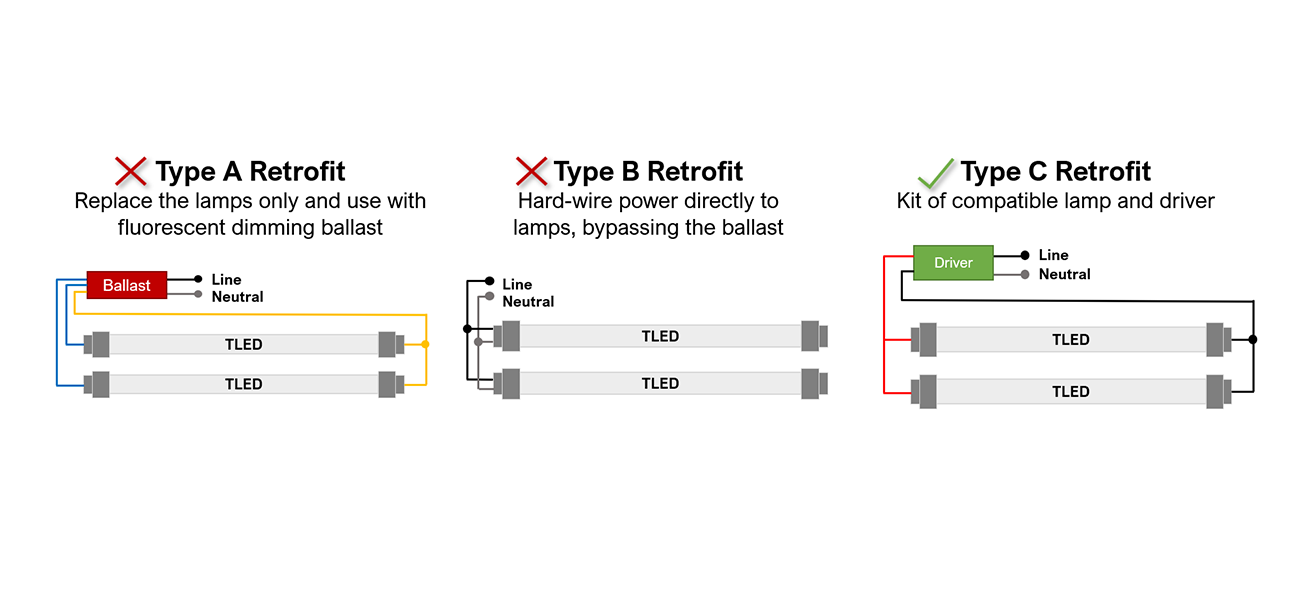
Retrofit Kits are divided into Type A, Type B, and Type C categories, each of which has its own set of benefits and considerations. We’ll discuss each type in detail, but If your primary goal is to maintain your Lutron dimming system and your existing fixtures, a Type C retrofit kit is your best option. With a Type C kit, you reset the useful life of your existing fixture with a straightforward lamp and driver replacement, and you can start with even a single fixture.
Type C Retrofit Kits: The Best Choice to Maintain Your Lighting Control System Performance
Type C retrofit kits replace fluorescent lamps and ballasts by providing new TLED lamps and LED drivers.
BENEFITS: A significant advantage of the Lutron Ballast Retrofit Kits by C-Flex is that they are a 1:1 retrofit (see diagram below), available for most standard lamp types and sizes. Each kit is guaranteed for compatibility and performance. The work and time involved in retrofitting a fixture with a type C kit is typically the same as replacing the fluorescent ballast and lamps, and it allows you to maintain both the dimming performance and connection to the control system.
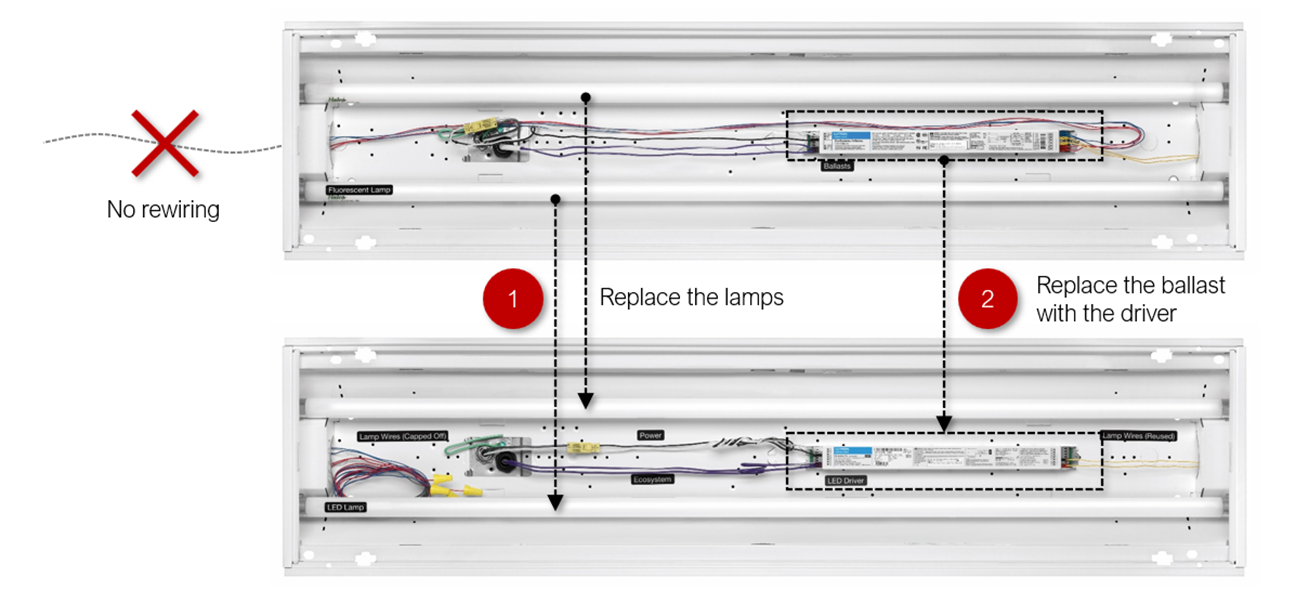
CONSIDERATIONS: Because they involve replacing the fluorescent ballast with an LED driver, Type C retrofit kits will have a higher upfront cost than Type A or Type B kits, but they remove the risks associated with the other options.
Type C Bottom Line:
- Fluorescent lamps and ballasts replaced with LED lamps and drivers
- Effectively resets the useful fixture life without rewiring
- Compatible with installed Lutron lighting control system
- Fast, easy, and reliable
Lutron has partnered with C-Flex to offer UL-Listed, DLC-certified retrofit kits for a wide variety of lamp types and color temperatures to match your existing fixture specifications. Watch this short video for a step-by-step tutorial on how quick and easy it is to upgrade your Lutron fluorescent dimming ballasts to LED drivers.
Type A and Type B Retrofit Kits Provide Economical, On/Off Switching Control
BENEFITS: Type A and B retrofit kits are acceptable solutions for non-dimmed systems.
CONSIDERATIONS: If used with dimmed fixtures, both Type A and Type B kits have critical pitfalls to be aware of.
Type A
With Type A retrofits, only the lamps are replaced – swapping the fluorescents for LEDs. For a switched fixture, this is an acceptable, low-cost update, but for dimmed fixtures it can be problematic. When used with dimmed fixtures, the LED lamp is being controlled by a fluorescent dimming ballast – which is not compatible largely because the low voltage of the lamps causes the fluorescent ballast to operate in a mode for which it was not designed. This can cause the ballast to fail in short order, forcing your team to retrofit the fixture again, with any initial cost savings being negated by the rework.
Type A Bottom Line:
- Only lamps replaced
- Relies on existing fluorescent ballast, that may be old
- Not compatible with Lutron fluorescent dimming ballasts
- Fast, easy, and cheap
Type B
With Type B kits, the fluorescent lamps are swapped with LED lamps, and the power is rewired directly to the lamp holders, bypassing the fluorescent ballast. Bypassing the dimming ballast means you’ve lost control over that fixture. Any associated timeclocks and sensors will no longer control it, and the light will permanently operate at 100% output. This approach can also lead to damaged switching controls due to high inrush current.
Type B Bottom Line:
- Only lamps replaced, ballasts are bypassed
- Substantial rewiring
- Loses dimming/programming/control capabilities
- Can damage controls
Special LED Upgrade Situations: Door Kits & Custom Retrofits
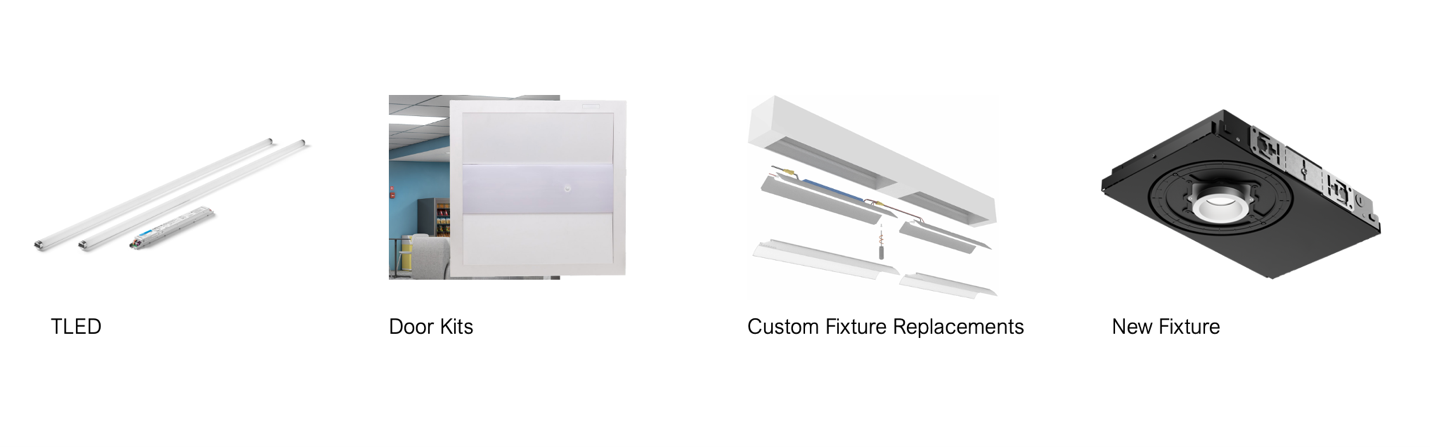
For troffer fixtures, door kits allow you to replace the internal fixture components with a one-piece LED insert. This option provides a new fixture look and improved lighting performance while avoiding installation issues.
Custom LED retrofit solutions meet unique requirements for specialized fixtures in large-scale applications. Custom retrofits generally involve replacing the internal lamp components with LED components while otherwise keeping the fixture intact. Fixture age and condition should play a significant role in your decision, and a mockup is recommended to ensure performance.
Beyond Retrofits – When to Consider A Full-Scale Fixtures and Controls Upgrade
Depending on the age of your existing fixtures, lighting performance goals, and budget, new LED fixtures offer the best control, versatility, and opportunity for optimal lighting performance – and a beautiful new look for your space! If you’re ready for a comprehensive LED fixture replacement, it might make sense to install new fixtures and an updated control solution that delivers smart features and an improved look.
Pairing these fixtures with a new lighting control system offers many advantages: tunable white control, synchronized light and shade control, Individual fixture control, app-based programming, and cloud-connected lighting control management software that simplifies system maintenance and improves the space. The right choice will depend on your budget, timeline, and goals. Regardless, planning ahead is the key to ensuring a smooth transition to LEDs and improved lighting performance.
We’re Here to Help
To choose the right retrofit kit for your space, use this cross-reference tool: Ballast Look-up Tool. Input your existing fluorescent ballast part number and desired color temperature, and the tool will recommend the proper kit.
At Lutron, our team of experts is available to help you make informed decisions for your building. We are committed to taking care of our customers, and we’re here to help you design energy-efficient, code-compliant, future-forward solutions. For more information, visit our Upgrading to LEDs webpage.

About the Author:
About the Author:
Tom Shearer is a commercial business development manager at Lutron Electronics, where he works with institutions and facility professionals to implement lighting and control solutions that drive energy savings, sustainability, and operational efficiency. He has authored multiple industry articles and regularly contributes to thought leadership on smart lighting strategies across the built environment.